Spanning opera, film, theatre, and immersive tech, Kasia Głowicka works where emotion, precision, and experimentation collide. As a composer, she’s written VR operas that turn the metaverse into a stage, premiered works at the Venice Biennale and Warsaw Autumn, scored documentaries, and created genre-bending music-theatre for the Polish National Opera and Teatr Studio. Her sound — minimalist in form, cinematic in force — moves between intimate detail and widescreen imagination.
Beyond composing, Głowicka investigates how creativity shapes human connection and decision-making. She leads the Connected Creativity programme and serves as a researcher at the International Music Industry Lab at Inholland University of Applied Sciences in Amsterdam. She speaks and teaches on creativity, empathy, and the future of artistic practice, and is currently writing a book that brings these threads together.
Full biographyOct 2026CHORNOBYL40 online residency complete
Głowicka has finished the eight-week online residency of CHORNOBYL40, the international art-science-tech programme marking forty years since the disaster: talks, mentoring and conversations with artists from across Europe and Ukraine.
One session stayed with her: Sophia Bulgakova on turning traumatic events into art. Making work from your own experience can feel cathartic, while working with other people’s experiences can feel like re-living them, and the emotional cost is real. After years of giving voice to stories that belong to others, she found it valuable to name this openly.
The residency also pushed her into new territory. Encouraged by Mélanie Courtinat, she has begun making visuals with code, her first steps into digital artistry.
Thanks to the CHORNOBYL40 team, especially Nataliya Velykanova and Valeriy Korshunov, and to Nikolaj Stausbøl, Mélanie Courtinat, Tim Deussen, Ugo Arsac and Sophia Bulgakova for sharing their expertise.
Sept 2026Fonds Podiumkunsten supports Cantata for Flesh and Code
Fonds Podiumkunsten has awarded a grant towards Cantata for Flesh and Code, a work for countertenor, AI voice, organ and electronics premiering in 2027.
The grant also covers Nobody’s Business, the podcast series developed alongside it, which looks at the hidden economics of making a living as an artist — what the work actually costs, and who absorbs that cost.
Aug 2026Selected for CHORNOBYL40
Głowicka is among the artists selected for CHORNOBYL40, the European project marking forty years since the disaster.
Selected participants take part in a research residency, after which a smaller group of projects will be produced and shown in a touring exhibition in Madrid, Berlin, Toulouse and Kyiv in 2027. The project is co-funded by the European Union and led from Kyiv.
Her proposal is a multichannel audio installation that begins with the iodine solution handed out across Poland in 1986 — and with what has grown back since.
Jul 2026Conference paper - Opera Decolonized: Listening to Afghan Women's Voices (Art of Research, Aalto 2026)
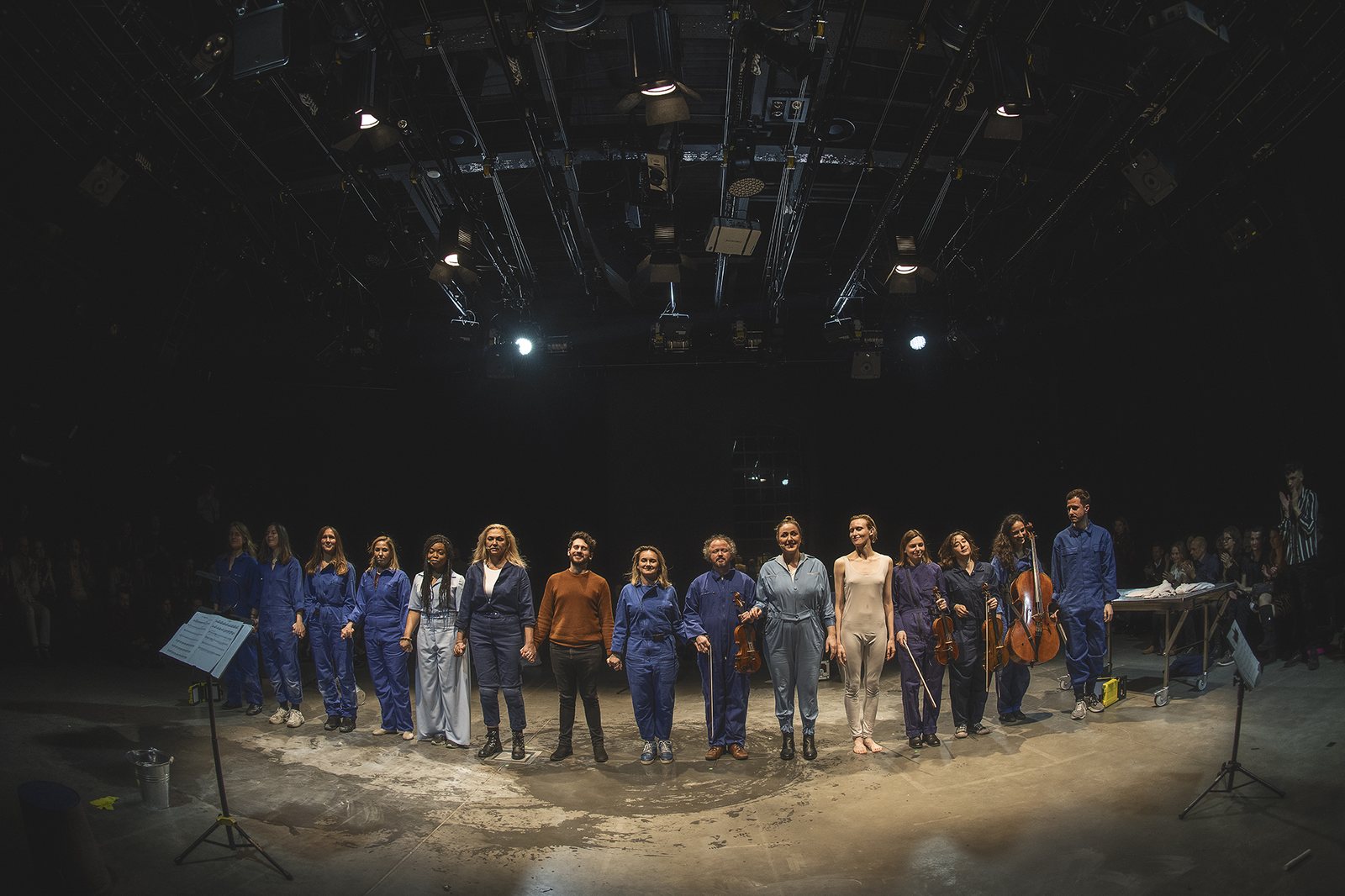
From Silencing to Listening: Opera-Installation as Cross-Cultural Medium for Afghan Women’s Voices
Paper presented at the Art of Research conference at Aalto University (2026)
Summary
Unknown, I Live With You (2018) was built around a problem: how do you bring clandestine writings by Afghan women into a Western artistic space without reproducing the very structures that silenced them? This paper, written as a member of The Airport Society collective, traces the formal decisions behind the opera-installation — venue, costume, casting, composition, audience placement, temporal structure — and argues that each one was an ethical choice as much as an artistic one.
At the heart of the argument is opera’s fundamental strength: a form where music, staging, dramaturgy, costume, and space are genuinely co-equal, demanding total presence from its audience. The paper asks whether that quality can be turned against opera’s own colonial tendencies — and whether a non-hierarchical working process, from democratic decision-making to shared yoga sessions before rehearsals, can mirror and reinforce what happens on the stage.
The paper will be presented at the Art of Research 2026 conference at Aalto University. It is currently available as a preprint on SocArXiv.
Links
Preprint: From Silencing to Listening — SocArXiv
Related links:
Unknown, I Live With You — OperaVision · Afghan Women’s Writing ProjectConference: https://events.aalto.fi/en/3X3IKxA7/g/82Z1zDshz8/art-of-research-2026-4a3bQtTRKz/overview
Citation
Głowicka, Kasia. 2026. “From Silencing to Listening: Opera-Installation as Cross-Cultural Medium for Afghan Women’s Voices.” Preprint. SocArXiv. https://osf.io/preprints/socarxiv/m2hnq_v1.
- 26 Nov 2026 · 17:00Presenting Decolonizing Opera @Art of Research Conference, Helsinki, FINLANDAalto University, Otakaari 1, 02150 Espoo, Finland
- 26 Nov 2026 · 18:00Presenting Decolonizing Opera @Art of Research Conference, Helsinki, FINLANDAalto University, Otakaari 1, 02150 Espoo, Finland
- 23 Jan 2027 · 17:15Try out Nobody's Business @ Studio ARTEk